Johnson County Dog Registration Information
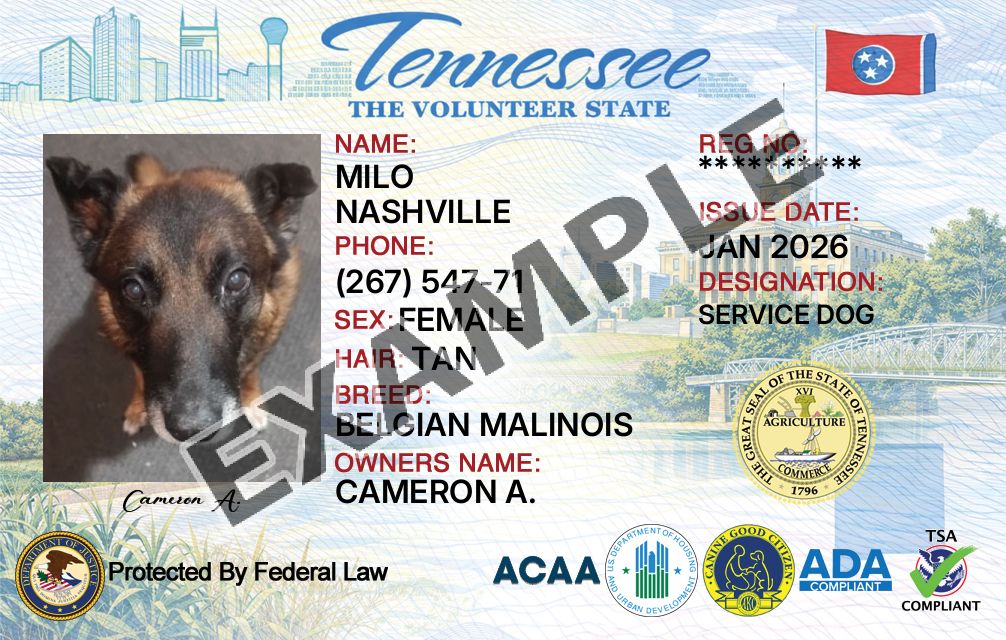
Service Dogs and Emotional Support Animals in Johnson, Tennessee
If you’re asking where do I register my dog in Johnson County, Tennessee for my service dog or emotional support dog, the answer usually depends on local rules—because dog licensing and rabies enforcement are typically handled at the county and/or city level. In practice, most residents start by contacting local government offices connected to public health (rabies documentation) and animal control / law enforcement (stray, bite, and ordinance enforcement). This page explains how local dog registration commonly works, what paperwork you may need, and the important legal differences between a dog license in Johnson County, Tennessee, a service dog, and an emotional support animal (ESA).
Where to Register or License Your Dog in Johnson County, Tennessee
Because licensing is often handled locally, the best way to find where to register a dog in Johnson County, Tennessee is to contact official Johnson County offices that oversee (1) rabies vaccination documentation and (2) animal control / enforcement. Below are several example official offices that Johnson County residents commonly contact first.
Johnson County Health Department (Johnson County, TN Government)
Why contact this office: The local health department is a key public agency for rabies-related public health processes (for example, documentation and guidance after bites, vaccination proof questions, and referrals to the right local enforcement office).
Johnson County Government (Courthouse)
Why contact this office: If Johnson County uses a county office for tag issuance, renewals, or local ordinance questions, the courthouse is often the hub that can route you to the correct department.
Johnson County Sheriff’s Department (Enforcement / Animal-Related Calls)
Why contact this office: In some rural counties, animal-related enforcement (strays, dangerous dog complaints, bite reports) may be coordinated through law enforcement if a separate county animal services department is limited or not clearly published online. Ask who handles animal control dog license Johnson County, Tennessee questions and rabies-tag enforcement locally.
Town of Mountain City (City Hall / Local Ordinances)
Why contact this office: If you live inside Mountain City limits, the town may have its own pet rules (leash laws, nuisance rules, and sometimes licensing/fees). Ask whether Mountain City issues local dog tags or if licensing is handled by a county office.
Overview of Dog Licensing in Johnson County, Tennessee
What a “Dog License” Usually Means
A dog license in Johnson County, Tennessee usually refers to a local registration requirement (often tied to rabies vaccination proof) that may result in a tag for your dog’s collar and a record that links the dog to an owner address. Depending on local ordinances, licensing may be administered by a county office (sometimes finance/trustee/courthouse-related) or a city office if you live inside city limits.
Because Johnson County is a local jurisdiction, the most reliable way to confirm the correct licensing authority is to start with the official offices listed above and ask: Who issues dog licenses/tags for my address, and what proof do I need? This is the fastest path to answering where to register a dog in Johnson County, Tennessee without relying on third-party companies.
Rabies Vaccination Requirements (Why They Matter for Licensing)
Rabies rules are a core reason dog licensing exists. Local governments rely on rabies vaccination documentation to protect public health if a bite occurs, and many licensing systems require current rabies vaccination proof before a license/tag is issued or renewed.
If you’re unsure what documentation is acceptable (certificate vs. vet record, what dates must be shown, whether a tag number is required), the Johnson County Health Department is an official starting point for rabies-related questions and referrals to the right local enforcement channel.
How Dog Licensing Works Locally in Johnson County, Tennessee
Step-by-Step: A Practical Local Checklist
- Confirm whether your address is inside a city limit. If you live in Mountain City (or another incorporated area), you may have city-level rules layered on top of county expectations.
- Gather rabies vaccination proof. Many offices will ask for a rabies certificate that shows the veterinarian’s information, the vaccination date, and the expiration/next due date.
- Call the correct local office before visiting. Ask who handles tags/licensing for your area and what payment methods are accepted (and whether renewals can be done by mail or in person).
- Ask about enforcement and what the “license” is used for. In many places, the dog license/tag helps reunite lost pets and supports rabies compliance tracking. It may also be required for certain local services or to avoid citations.
County vs. City: Why “Local” Matters
Residents often assume there is one statewide registry. In reality, “registration” for pets is mostly local: the county and/or city decides who collects fees, who issues tags, and which department responds to issues like loose dogs, bites, and nuisance complaints. That’s why you’ll see terms like animal control dog license Johnson County, Tennessee—the enforcement side and licensing side often work together even when handled by different offices.
What If You Have a Service Dog or ESA?
Even if your dog is a service dog or emotional support animal, your local government may still expect compliance with core public health and safety rules (like rabies vaccination). However, service dog access rights and ESA housing accommodations are separate legal topics from local pet licensing.
Service Dog Laws in Johnson County, Tennessee
What Makes a Dog a Service Dog (Legally)
A service dog is generally a dog that is individually trained to do work or perform tasks for a person with a disability. The legal status comes from the dog’s training and the handler’s disability-related need—not from a paid certificate, vest, or online registration.
Do You Need to “Register” a Service Dog with the County?
In most situations, there is no special county-level “service dog registry” required to make a service dog legally recognized for public access. What you may still need is the same local compliance as any other dog: current rabies vaccination and any locally required dog license/tag. That’s why the most accurate approach is to ask your local office: Do you require a standard dog license/tag even for service dogs?
Public Access vs. Dog Licensing
Public access rights for service dogs relate to where the dog can go with the handler. A local dog license relates to identification, rabies compliance, and local ordinance enforcement. They are separate systems, and you can have one without the other—though many owners maintain both to avoid problems.
Emotional Support Animal Rules in Johnson County, Tennessee
What an Emotional Support Animal Is (and Is Not)
An emotional support animal (ESA) is typically an animal that provides emotional support that helps with a psychological or emotional condition, supported by clinical documentation for certain accommodations (most commonly housing-related). ESAs are not the same as service dogs and generally do not have the same public access rights.
Do ESAs Need a Special License Tag?
Usually, no special tag is required solely because a dog is an ESA. If your locality requires general dog licensing, the ESA would typically follow that same process (rabies proof, local fee, tag). If you’re trying to figure out where to register a dog in Johnson County, Tennessee for an ESA, focus on the standard local licensing process and keep your ESA documentation separate for housing requests.
Housing Requests vs. Licensing Questions
ESA documentation is most relevant when you are requesting a reasonable accommodation in housing. Dog licensing is a local government compliance topic. If you’re working with a landlord, your “ESA paperwork” is typically not submitted to the county for a dog license—rabies proof is the common overlap.
Frequently Asked Questions
Register A Dog In Other Tennessee Counties
Select your county below to get started with your dog’s ID card. Requirements and license designs may vary by county, so choose your location to see the correct options and complete your pup’s registration.
- Anderson County Dog Registration
- Bedford County Dog Registration
- Benton County Dog Registration
- Bledsoe County Dog Registration
- Blount County Dog Registration
- Bradley County Dog Registration
- Campbell County Dog Registration
- Cannon County Dog Registration
- Carroll County Dog Registration
- Carter County Dog Registration
- Cheatham County Dog Registration
- Chester County Dog Registration
- City of Hartsville County Dog Registration
- City of Lynchburg County Dog Registration
- City of Nashville County Dog Registration
- Claiborne County Dog Registration
- Clay County Dog Registration
- Cocke County Dog Registration
- Coffee County Dog Registration
- Crockett County Dog Registration
- Cumberland County Dog Registration
- Davidson County Dog Registration
- Decatur County Dog Registration
- DeKalb County Dog Registration
- Dickson County Dog Registration
- Dyer County Dog Registration
- Fayette County Dog Registration
- Fentress County Dog Registration
- Franklin County Dog Registration
- Gibson County Dog Registration
- Giles County Dog Registration
- Grainger County Dog Registration
- Greene County Dog Registration
- Grundy County Dog Registration
- Hamblen County Dog Registration
- Hamilton County Dog Registration
- Hancock County Dog Registration
- Hardeman County Dog Registration
- Hardin County Dog Registration
- Hawkins County Dog Registration
- Haywood County Dog Registration
- Henderson County Dog Registration
- Henry County Dog Registration
- Hickman County Dog Registration
- Houston County Dog Registration
- Humphreys County Dog Registration
- Jackson County Dog Registration
- Jefferson County Dog Registration
- Knox County Dog Registration
- Lake County Dog Registration
- Lauderdale County Dog Registration
- Lawrence County Dog Registration
- Lewis County Dog Registration
- Lincoln County Dog Registration
- Loudon County Dog Registration
- Macon County Dog Registration
- Madison County Dog Registration
- Marion County Dog Registration
- Marshall County Dog Registration
- Maury County Dog Registration
- McMinn County Dog Registration
- McNairy County Dog Registration
- Meigs County Dog Registration
- Monroe County Dog Registration
- Montgomery County Dog Registration
- Moore County Dog Registration
- Morgan County Dog Registration
- Obion County Dog Registration
- Overton County Dog Registration
- Perry County Dog Registration
- Pickett County Dog Registration
- Polk County Dog Registration
- Putnam County Dog Registration
- Rhea County Dog Registration
- Roane County Dog Registration
- Robertson County Dog Registration
- Rutherford County Dog Registration
- Scott County Dog Registration
- Sequatchie County Dog Registration
- Sevier County Dog Registration
- Shelby County Dog Registration
- Smith County Dog Registration
- Stewart County Dog Registration
- Sullivan County Dog Registration
- Sumner County Dog Registration
- Tipton County Dog Registration
- Trousdale County Dog Registration
- Unicoi County Dog Registration
- Union County Dog Registration
- Van Buren County Dog Registration
- Warren County Dog Registration
- Washington County Dog Registration
- Wayne County Dog Registration
- Weakley County Dog Registration
- White County Dog Registration
- Williamson County Dog Registration
- Wilson County Dog Registration